Friday, November 20, 2009
Leadership and Management Training - Toastmasters Style
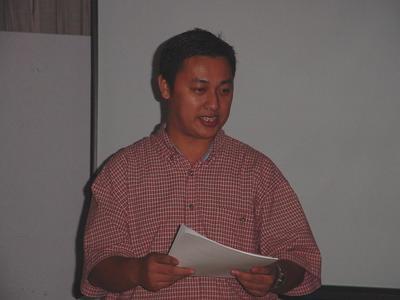
This post is inspired by an educational speech I delivered at El Presidente Toastmasters club. Thanks to club President Marilyn Abella for the opportunity.
When people join Toastmasters it is mostly for one purpose and that is to enhance their public speaking skills. What not too many people appreciate is that Toastmasters is a great training ground for developing leadership and management skills among others. the functions members play is a practicum for some corporate management roles. Let me cite them one by one.
In case you don't get to finish reading this post, be forewarned that the Toastmasters Leadership Training that I am tackling here only works for those who want and strive to be better. Practically nothing can be learned from mediocrity. This only applies to those who subscribe to the idea that anything worth doing is worth doing well. Read on for more learning.
Saturday, October 14, 2006
Break the Rules by Edwin C. Ebreo: Speech # 10
There is however a good deal of contradiction between following rules and greatness. Great people didn’t become what they are by following rules, they make their own even if they pay a high price for it. Galileo was deemed crazy and a heretic, Columbus was ridiculed, Bill Gates, well, Bill Gates became a billionaire. These men of history proved that some rules are meant to be broken and that for most of them it pays to break them. Some men broke some rules to make this world better. I would forever be indebted to the person who broke the rules about beach attires and invented the bikini… but not as much as the man who made earth-bound human beings fly via the airplane.
Wait; don’t go about breaking rules yet. You must learn to differentiate breaking rules that lead you to the bank from the ones that deservingly lead you to prison. There are also rules for breaking rules you know and here they are:
Believe that there are many correct answers – From elementary school to college, we’ve been taught that 1 + 1 = 2, My kindergarten teacher taught me to color the sky blue and the grass green when I draw. I heard of one who had a different answer. He colored his sky violet and the grass gray. When he was told it's wrong, he asked “why, that’s how I see the sky during sunset”. There are many correct answers, and sometimes, the second, third or fourth correct answer is the one that breaks the rule big time! Emilie Chartier said “Nothing is more dangerous than an idea when it is the only one we have.” Next time you are challenged by a problem, ask yourself questions that require plural answers, what are the solutions rather than what is the solution.
Know that it does not make sense to say that it does not make sense – People like to reject new ideas like a body rejecting a strange protein. I think it was One of the Warner Brothers who said “who wants to hear actors talk?” during the time of silent movies. We've been fond of saying “it does not make sense’ when we hear ideas that are out of whack or seemingly out of this world. I wonder how many of them were heard by Einstein, or Edison or the guy who invented golf.
Be ready to challenge the rules - Do you know why the keyboard in your computer is arranged that way? That’s because when the type writer was invented, the inventor got complaints that the type sets were getting stuck when they type fast. In order to prevent the typist from typing fast, they put the commonly used vowels in such a way that the weak fingers will be used to hit them. Does that reason apply today now that we are using computers? You bet not! That’s why somebody invented the devorajk system, I bet some of you don’t know that. So next time you see some rules, ask are these rules still applicable? Does it still serve its purpose? If not, break it.
Be foolish – Especially when smart means being conventional and conforming to the accepted norms. “Don’t be foolish” is what Economic and Business Experts said when Henry Sy planned to build the SM city in the middle of nowhere at a time of great economic turmoil following Ninoy Aquino’s assassination. Look how his business is now! If that’s what you call foolish, I hope we can make similar foolish decisions.
Don’t let failure stop you from trying – What makes great people different from ordinary mortals is not the amount of success that they've achieved but the amount of times they try after each failure. Edison counted 1001 wrong ways to make a light bulb before he can find the best solution.
Ladies and Gentlemen, every piece of innovation in this world is a deviation from the norm. Without rule breaking we’d still be in caves or worse, we could have been extinct. Occasional rule-breaking therefore is essential to survival. My father gave me a great advice about rules when I was in high school. He told me rules are relative truths, they must change overtime. Books are references, not rules to be followed. You don’t live your life because books tell you so. You can choose to disagree, even make your own rules for as long as you make sure that you don’t hurt people. He also said that you cannot be in the business of breaking rules if you keep on saying it cannot be done because those words have the tendency to become a self-fulfilling prophecy.
Before I end, I must repeat that rules are important. They are boxes that keep things in proper order. But sometimes we need to go out of those boxes in order to create new orders. Go out of oft-trodden path and create new paths. I read from somewhere that one cannot be better without changing the way one does things, so change the way we do things we must! In this business of rule breaking, the only limit is your imagination, so use your imagination to find all the right answers in making this world a better one to live in.
Now go break some rules.
A Leader Wears Many Hats by Edwin Ebreo Speech# 8
Kings Crown – Although this doesn’t necessarily qualify as a hat, there are times when you need to wear it because you are expected to make wise judgment, and to rule and rule firmly on matters concerning your team. At times we have to make like kings. Make decisions that are good for the people and not necessarily make decisions that they like.
Lady’s hat – Whether you are male or female, you will need to wear the lady’s hat more often than you think you should. The lady’s hat represents sensitivity and maternal instinct. As leaders we need to be sensitive to the needs of our team. Look after their welfare like a mother looks after the welfare of her children.
Chef’s hat – The success of the chef depends on his ability to bring harmony to the food he cooks. His skills in putting together the right amount of right ingredients spells the difference between heaven and hell. Do you have the Chef’s skill in picking the right ingredient for your team? Do you see the potentials of each team member to contribute to the success of the team in the same way that a chef makes heavenly food out of things that are otherwise ordinary?
Fireman’s hat –No matter how negative it sounds, firefighting is something that leaders have to do. This is because no matter how much you prevent them problems do occur and a leader must be prepared to take on these problems as firemen tackle fire. Putting out a fire can leave a sense of great accomplishment, just like solving a problem, you can get used to it. You must remember however, that fires or problems cause damage no matter how quickly you fix them. Never forget that it is always better to prevent fire than to putting it out.
Baseball cap - This represents the coach’s cap. This is also the hat that requires the least explanation because it is the one most closely associated with leadership. However there is another person who also wears the same hat, the player. This reminds us that the coach, just like the player is a member of the team. They are on the same side not the opposing side. Always remember that whenever you feel like punching a team member on the nose.
Nurse’s cap – The nurse’s cap should remind you that your role is to serve. Whenever you feel that the hurts or pains of your team members is not your business, remember that you must also wear this hat. When members do not perform in the way that they are expected, you should be able to see signs and symptoms and help find a cure. Sometimes the cure is a bitter pill. Keep in mind that you do this not to make them suffer but to make them well.
Farmer’s hat – I put the farmer’s hat last because I believe that this is a very important hat. A farmer looks at a barren land and sees its potentials to bear fruits. And because he believes that “what he sow, he shall reap, he rolls up his sleeves and get down to work, cultivating the land, planting the seeds and watching over it until it bears fruit. Please note, I said watching over, not just watching. There is a big difference.
There you have it folks, the different hats we wear as leaders. It’s easy to fall in love with the hat that works best for us. But that ladies and gentlemen is what I call forbidden love. Never think that wearing just one hat is enough to get you by. As a leader, you have to be sensitive to the situation and the people and be aware of the hat that you must wear. So, choose your hats wisely and lead effectively.
Wednesday, March 15, 2006
Managing Your Boss by TM Edwin Ebreo
"Good morning boss! You look really terrific today boss! Did you like the necktie I gave you for your birthday?.. You know, your good for nothing other staff Caloy, he messed up his work again. I already told him to be careful because that project was important to you but he doesn’t seem to know anything!!!"
Ladies and gentlemen, fellow toastmasters, my speech tonight has nothing to do with those. A little kissing up to the boss may help lubricate the relationship a bit but, too much of it and too few of everything else can only get you closer to his or her behind and nothing further.
For as long as you work in an organization, you will always have a boss, someone you report to and is responsible for your performance. He or she can be the big help you are looking for in succeeding in your career, but s/he can also be the biggest hindrance if you don’t know how to manage your boss.
There are perhaps tens even hundreds of tips out there on how to manage your boss, but let me give you five of the most important tips you can use as you traverse your professional life.
- Pay attention, in short, know your boss, pay attention to how your boss works or what is important to him. Is he very organized? Is he a slob? A know it all, or a know nothing? Does he enjoy being more of a hands-on leader? Give him a chance to be a hands-on leader by asking his help or seeking his advice. Is he a free-reign type? Be resourceful enough to earn his trust and give him updates on your progress. Ask him for his expectations. Compile a list of the 3-5 things that define the management style of your boss. Keep these items in mind when interacting with him.
- No Surprises. I remember a time when I saw my staff, Caloy nervously pacing about in his cubicle. Since, that was not the first time I saw him do that, I also nervously asked him what the problem is. He took a deep breath and said, we’ll you see it’s like this… He went on giving tons of excuses on why we have to pay an employee his medical reimbursement because he forgot to process the SSS reimbursement request, and has been hiding the problem away from me for weeks! I know now how incredible my patient is because, he tested it a lot! (pregnant pause) The key here is always keeping your boss in the loop. If it's good news, share it and share the credit, thank your boss for his support even if he didn’t have single thing to do with it. If it's not good news, don't try to hide it. Your boss will find out, and it will be worse if it doesn't come from you. And if you made a mistake, take full ownership of it, present some possible solutions, and detail a plan that will prevent it from happening again.
- Bring Solutions. I learned this the hard way. I was then a store supervisor in a convenience store. I went to my boss to tell her that we have a problem. My boss said, “did I hear you right? Did you say we have a problem?” “y-yes ma’am, was my uncertain reply.” She smiled at me and said. Let me correct you on that Ed, I don’t have a problem. Maybe you have a problem, but I don’t… From that experience I realized that when there is a challenge, you have to be sure you've already assessed the options before going to your boss. If your boss is needed to make a decision, present the challenge, and then present the possible solutions. Be prepared to explain the ramifications - both the rewards as well as the risks - of your suggestions. Never, never go to your boss without a suggested solution unless, you’re absolutely clueless.
- Communicate, communicate, and communicate. Don't expect your accomplishments to automatically get noticed. Some bosses are as blind as bats in recognizing accomplishments. Make sure your boss is aware of them without sticking your accomplishments to his face. Understand exactly what your boss is looking for and expecting from you. Understand what he/she uses to evaluate your performance and make sure that he sees you meeting his expectations. This is called Visibility.
Positive Attitude. Your talent determines what you can do. Your motivation determines how much you can do. Your attitude determines how well you do your job. Everyone likes and respects a winner, yes, even your boss. So what is the positive attitude you need to have? Think like a winner, be a winner.
Sunday, March 05, 2006
Dawn of the Dead by TM Edwin Ebreo
Look around you, when you walk the streets, when you drive your cars, whether day or night, when you are stuck in traffic, you will see them, walking aimlessly so it seems, but what they are doing is waiting to pounce. Look in their eyes and you’ll see glassy emptiness. They look at you as if they see you and yet they don’t. What they see is food, food for their empty stomachs.
What in heaven’s name are you talking about Ed? Well, I happened to watch the movie Dawn of the Dead in DVD lately. Who among you have seen a zombie movie? There are many of them, "Attack of the Living Dead", "House of the Living Dead" and lately "Land of the Living Dead". I’ve always found these movies rather silly, with dead people walking around like this… the zombies were rather slow and witless you can practically live with them. When they attack you like that, you can just say, "get out of my way". That’s where dawn of the dead is different, the zombies in the movie moved fluidly, very lifelike without the catatonic rigidity of the old zombie movies but with the same menacing behavior. But I’m digressing from my real topic which is the social relevance of these zombie movies. Would you believe that after watching so many of them I finally realize that they do have social relevance.
It dawned on me just last December, while I was inside a cab. I got caught in traffic. A beggar knocked on the car window. I’m not so fond of giving alms but for the sake of Christmas spirit I gave the beggar the few coins that I got in my pocket. In a matter of seconds, about five or six more of them are now knocking on the car window doing this… It reminded me of a scene in the movie when zombies attacked one of the protagonists inside the car. Can you imagine it? You might say that the comparison is cruel and far-fetched, but listen. The truth is the only difference between the living dead in the movie and the living dead we have in our midst is that the ones in the movies eat people.
Living dead, that’s how some people have practically become. They stopped living, and are merely surviving, with goals reduced to finding food… or drugs, in whatever means possible. It is a sad pathetic life, if you can call it a life, with aspirations given up, with no contributions to give. They sit there on the pavements or walking around aimlessly, begging for alms, or stealing, victimizing the living. I see more of them today, than when I was twelve. If things go as they do, there will be more of them in the future, and no sooner will we become a land of the dead. Dead hopes that is, a dead opportunity to live a descent respectable life. What can stop it? Can we do anything about it? Individually no, but as a whole community we can. We can help them live again.
These people, they don’t need alms or pittance. They need hope, a chance to live again, an opportunity to become a contributing member of the society. They need work. They need to learn how to work. You might say, you are asking too much of us Ed. I don’t need you to act now, I need you to think, to keep what I am saying in your mind, and maybe in your own way help them, help themselves. Find organizations that aim to help these people by giving them work or teaching them how to do work, and support them. In our own little way, I’m sure we can make a difference. If you give them fish, you feed them perhaps for a day , when you teach them how to fish, you feed them for their lifetime.
Thursday, October 06, 2005
Ten Times Larger than Life by TM Edwin Ebreo
You probably heard this phrase before… I first heard it when I joined a theater group back in college. Our stage director always tell us to act 10 times larger than life. This means make big movements and exaggerate emotions because when we occupy the stage, the audience in the last row can only see us as 12 inch moving figures that if we do not exaggerate our movements and acting, it will be very difficult to get their attention. He told us that we are performing for an imaginary old lady seated in the last row who has poor eyesight and hard at hearing and that we ought to give her our best performance. He said that the poor old lady must feel the story, our happiness, our anguish and the message we are trying to convey or else we would have wasted her ticket.
“Acting is believing,” that is what he said. Before you can convince your audience that you are the role you are playing, you must first convince yourself. If your role is that of a beggar, you don’t just act like a beggar, you also, think like a beggar, feel like a beggar, even smell like a beggar. You must carry his burden, see yourself experiencing his pains, then and only then can you effectively play his role. I personally experienced this when I played a role in the play Ang Paglilitis ni Mang Serapio which won the first National Drama Competition in CCP, but that’s another story.
What did I learn from my short stint as a stage actor? When I went out into the real world I realized that everything my director told me still holds true. We need to act 10 times larger than life. I saw that the world is indeed a stage and all of us actors. The only good thing about this life stage is that we get to choose our role. We can choose to take big roles or small ones. We can choose to be heroes or villains or damsels in distress. Yes, we do not write our own stories, God does, but we have a hand in it whenever we choose how to respond to each situation presented to us. The plot thickens as we bring excitement to our own stories when we choose to face life’s challenges rather than succumb to them. Each of us has a story to tell. The ending could be happy or sad, successful or tragic. Endings are important as we all strive to make it a happy one but what’s more important is the fight we put in along the way.
As my stage director used to say, act 10 times larger than life. That is the way to affect others by your performance. Do not settle for mediocrity; strive for a performance worthy of an encore. What does this mean? Just like how people play roles in our lives, we also play roles in theirs. We should strive to touch their lives in the way we want our lives to be touched. Help in big and small ways, be your best for your sake and the sake of others. That my friends is a life performance worthy of an encore, for that is the way for people to want us to reappear in their own play.
So, what is your story? How are things unfolding? How are you at adding excitement into your life’s story? How do you want others to brand it? Adventure? Fantasy, Comedy, Suspense thriller or horror? You decide. What ever role you desire, pursue it believe in it, give it your best, act 10 times larger than life and, oh, Break a leg!
Seabiscuit by TM Edwin Ebreo
Two weeks ago, I bought a VCD of the movie Seabiscuit. I was looking forward to good entertainment, what I got was a lesson about life that I wish to share with you tonight.
Some of you are probably familiar with the story. If you say that it’s all about a horse, you’re mistaken. It was a true to life story of a homeless jockey, a millionaire, a washed up cowboy and a horse named Seabiscuit. Four unlikely heroes who found hope in each other and went to inspire a whole generation during the great depression. Let me tell you a bit more about them.
First is the jockey Red Pollard. Born in a wealthy family, Red was not prepared to live a difficult life during the depression. His parents lost all their wealth and practically sold him to a stable owner in order for all of them to survive. He earned his living riding race horses and fighting as a boxer. The problem was, he was too big and heavy as a jockey that he had to skip meals to keep his weight… and too small and ill-fed to win a decent boxing fight. He hardly succeeded in anything that he went into. He even lost sight in one eye due to a heavy punch. Later on, he broke his leg in a freak accident that doctors told him he will never ride again. What a loser!!! But this boy had the heart of a lion and a mind full of imagination. He wouldn’t give up even when the odds are incredibly bad. He rode Seabiscuit to a number of victories and towards history. The ultimate underdog champions
Now the cowboy, Tom Smith. He was like the last samurai of the west, fighting to keep a way of life that slowly gave way to progress. He lived in an era when “cowboyhood” lost its macho appeal and creatures like him became rare, uninteresting species. Not much was told about him except that he knew more about horses than horses knew about themselves. And one more thing, he was an exceptional teacher/trainer who saw beyond one’s limitations. He had an eye for talent no matter how deep it was buried.
The Millionaire was Charles Howard. Before the depression, he had the franchise of Buick for half the US. He was not a millionaire for no reason. Somehow there was a similarity between him and the cowboy Tom Smith. He knew where to place his bet; He placed a huge amount on Tom, Red and Seabiscuit. He lost some in the process but won big towards the end.
Now Seabiscuit, Seabiscuit was also called the long shot. You know why? He was small, hot headed, lazy, bitter and beat-up. Every trainer who handled him described him as incorrigible and gave up on him. How could a horse so out of his league become the champion of all champion horses? I’ll tell you why and this is the whole message of the story. Tom Smith played by the award winning actor Chris Cooper put it very succinctly in one scene and repeated a good number of times through out the movie. He said and please remember;
“You don’t throw a whole life away just because it’s banged up a little”.
You don’t throw a whole life away just because it’s banged up a little… There’s a familiar ring to it isn’t it?
If you look at the story closely and I encourage you to do so, like Red Pollard, the one-eyed jockey, how many times have we turned our backs on an intimidating challenge because we are afraid we don’t have what it takes? As teachers/leaders or managers like the cowboy Tom Smith, how many times have we been tempted to judge people under our charge that they don’t cut it? As investors, how do we deal with the prospects of losing over winning? And as an individual, how do we deal with people who refuse to bet on us because they just don’t see what we got? There is one common denominator in our four heroes, they refuse to look at what is seen, they went for what is felt, a desire to win, to believe, to fight a good fight…
Friends, I encourage you. Like Red Pollard, let’s look inside us and strengthen the desire to overcome our physical and mental limitations. I have a staff member who chose to take up a major in Math because she was bad with numbers. How about you, what can you do? Like the Horseman Tom Smith, look at the people who depend on us for guidance, they could be our children, our students or our employees. See beyond their inadequacies, and find out what’s in their heart. Let’s not think that they are too slow, too dense or too lazy to achieve something great. Do not dwell on what they failed to accomplish, rather, discover what they are capable of. Just look at Seabiscuit. Let’s invest on them like Charles Howard did and like Seabiscuit, let’s show the world that beneath these weak looking facades are great people capable of even greater feats.
Thursday, April 07, 2005
DON'T! By TM Edwin C. Ebreo

The moment you say you can’t, you won’t, so DON’T!
Everyday we are faced with fresh set of challenges, some of them small enough to undertake without much worry. Others are huge, seemingly insurmountable and almost impossible to chew. Wait, I said almost because what is possible and impossible depends a lot on our decision to say we can, or we can’t.
There are two major reasons why people say they can’t. One is because they have not done it before and doubt that they will ever be capable… or they have done it, but they failed so they then are afraid to feel the agony of defeat again. These are the two huge walls that may stop us from achieving success. These are the wall of doubts and the wall of fear. These walls can block our views of what is ahead. They stop us from achieving our full potential. You know what can break these walls? A small hammer called WILL! We all know what the Lord said about faith. He said that a faith the size of a mustard seed can move a mountain; I’d say the same about WILL. Will makes the impossible possible. Like man’s trip to the moon, the great wall of China and the mapping of human DNA. Imagine if no man of great vision thought all these things to be possible.
You know what they say… what does not kill you can only make you stronger… yes, even failure. Want some example? Think of the light bulb, think of the 1001 versions that failed to work which led to one that began to light our lives. Imagine Thomas Edison saying, “I failed! I give up!” or what if....he didn’t even try at all. Another example? Think of the Sticky Notes, a byproduct of a failure that led to a gazillion dollar business.
Now, imagine what you can accomplish if you are not afraid to explore possibilities. Look inside you and find that thing that you’ve been aching, yet so terrified to do
I always tell my children that pursuing a better life means, doing different things and doing things differently. Stick your neck out and take risk. Manage your fear and your doubts. Because if they run wild, they are both expensive and debilitating. Proof? If we try to put a peso value on all the opportunities we lost because of doubts and fears, I’m sure if we have those money in our hands, we’ll all be richer than we are right now. This shows we won’t get anywhere if you don’t break out of our shell…Get out of Your comfort zone.
So, what is it? A bad relationship that needs to be improved, a new challenge at work, a desire to better yourself? Go for it! Don’t be afraid and don’t say you can’t. Because when you say you can’t, you won’t… so don’t!
Don’t say I can’t.
Say instead… Yes, I can and do it… …
Tuesday, February 15, 2005
My New Pair of Shoes by TM Edwin Ebreo
The first two weeks with these shoes were like hell. On the first day I wore it, I complained about how heavy it is. I grew more blisters in my feet than you would care to know. At the end of the day, I was so tired and in pain that I wished I wouldn’t have to walk half a kilometer from the bus stop to my house. My body just reacted so negatively to the change and I wished my old shoes could stand more than 5 years of service. I had no choice though. I knew I had to endure the first few weeks in the same way that I did with my old shoes.
These shoes brought unwelcomed but necessary changes to my life, small, yes but necessary none-the-less. Which brings me to the point I’d like to drive at. We all have to face necessary changes in our lives at one time or another. We’d wish that the signs would be as obvious as in the case of my old shoes, but at most times, the most subtle hints bring the most impact, like the need to relate better with others or learn new skills. Most often our reaction to the need for change is that of denial. We make excuses in the same way that I say, what’s wrong with my old shoes? We all heard about that saying that goes, if ain’t broke, don’t fix it. We also say, this is who I am, what you see is what you get, take it or leave it. But the truth is we can’t wear the same shoes all the time and besides there are different shoes for different occasions. And on some, we will need an entirely different set of shoes. We all know that in order to get ahead in this life, we cannot stay in the status quo, we have to find ways to make improvements in our selves and adapt to the environment we live in. I say, don’t get caught wearing the wrong shoes!
So, what are the necessary changes in your life that you’ve been trying to push back for a long time? Taking up a new hobby, pursuing a relationship? acquiring a new skill? Joining Toastmasters??? What? You have better ways of spending your time and money? Why, is it too scary? The more excuses you make up, the longer it will take before you get to enjoy the benefits of the changes you need to make. Sure it’s inconvenient and painful at times. I’d be lying if I say it is not, but you know what, we all need changes like I need these new pair of shoes.
Ice Breaker by TM Edwin Ebreo
What made me what I am and how I got here is the story I am going to share to you tonight.. First off, I was born to a poor couple in 1971. My mother who never set foot in a class room until I was ready for kinder garten was a sidewalk vendor. My father who barely finished first year in high school was a laborer earning below the minimum salary. We have a very good reason to have a miserable life, but you know what we didn't. In my childhood I never felt we were poor. That's because my parents did their best to show me how to lead a good life. They gave me reason to be confident of my self. My mom made me believe that I was smart and good looking. My father said how can you not be, your father is smart and good looking.... Parents! You know, I don't think I outgrew that belief.
Just like most of us here, I also acquired my values from my parents. My mother taught me discipline and hard work by requiring me to clean the house, wash my clothes and sell stuff like pandesal, news paper, vegetables in the market and a lot of others. My father taught me to be resourceful and innovative and he gave me a good example. When I was 10, he worked in Oman in the middle east as a cook for Filipino engineers. The remarkable thing is, he can only cook rice! He brought along 5 cook books and substituted missing ingredients with MSG. Hmmm, I now wonder if the engineers lived longer than he did. His experience showed me that if you want something bad enough, you'll find a way to have it...
My father shared with me a remarkable wisdom. He said successful people make their own rules. The books he said are references not instructions, always keep an open mind and an open eye for opportunities to improve on what people already know... How do you beat that!
When I was fourteen my father died, my mother was devastated, I lost a moral compass. I was adrift for a long time that led me to marrying at age 19, making me give up education and all the good fortune I had at school as an editor, theater actor and all around popular guy!
I worked as a store crew at 7-Eleven and felt miserable for a while until I decided that everything is a temporary setback and thought to my self that I can do something to get to the top of the pile. I worked hard to get the break of becoming a supervisor, then a trainer, then a training manager, then an HR Manager and very recently an HR Director, taking care of all the HR needs of a group of companies.
Fellow toastmasters, I believe that at my current age of 133. I've experienced enough loss to appreciate what I have, enough poverty to to realize the value of hard work, enough failure to be humble and enough success to believe in my abilities as a person. And through all these I have one lesson to share... No guts, no glory, oh and another thing... Always wear a smile and the world will wonder what you are up to.